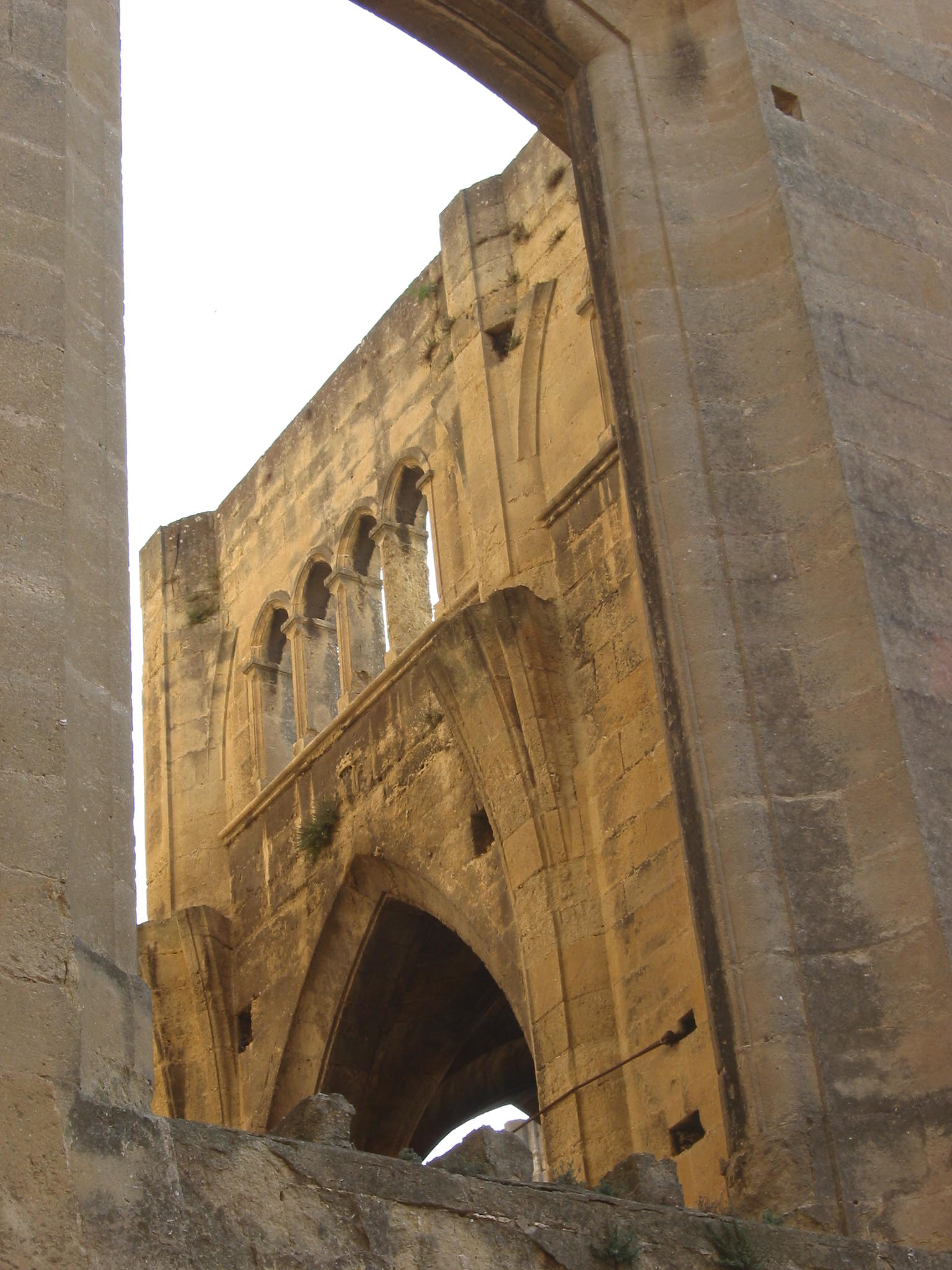
Train station, somewhere between France and Spain. The air is hot, dry, heavy, bright, and still as a desert night. Everywhere the sun hammers down on the dry sand and rock of the rolling almost desolate hills, reflecting and refracting and slowly boiling away any sense of comfort. The only mitigation to the unrelenting brightness is the whisper of a breeze that slips in between the hills and over the shoddy half-wrecked town from the sea – a thin wisp of blue against the horizon. Every hour and a half a train rumbles by. Some of them stop for a moment to pick up harried looking passengers whose faces grimace relief at their opportunity to leave. No one ever gets out of the trains.
The train station has one single deli – a tiny, vaguely air conditioned cave where sandwiches are sold at inflated prices. You spent your last eighty euro cents on a plain croissant, small enough to fit in the palm of your hand. After the last weeks training you could have lived a week on that eighty cents, but you were just so damn hungry.
It was Barcelona that broke you. The living expenses were so much higher then the earnings on the street, and it was a tough, tough crowd. Twice as much work for every laugh, and the smile on your face got more and more strained as you grew weary. Leaving came too late by a long time, but finally the risk had to be taken. In a last bout of desperate optimism you chose to visit the Dali Museum before you left Spain behind, and that may well have been worth it, despite the various problems it caused.

Las Ramblas Barcelona, a tough crowd. 
Barcelona Darla 
Barcelona Geoff
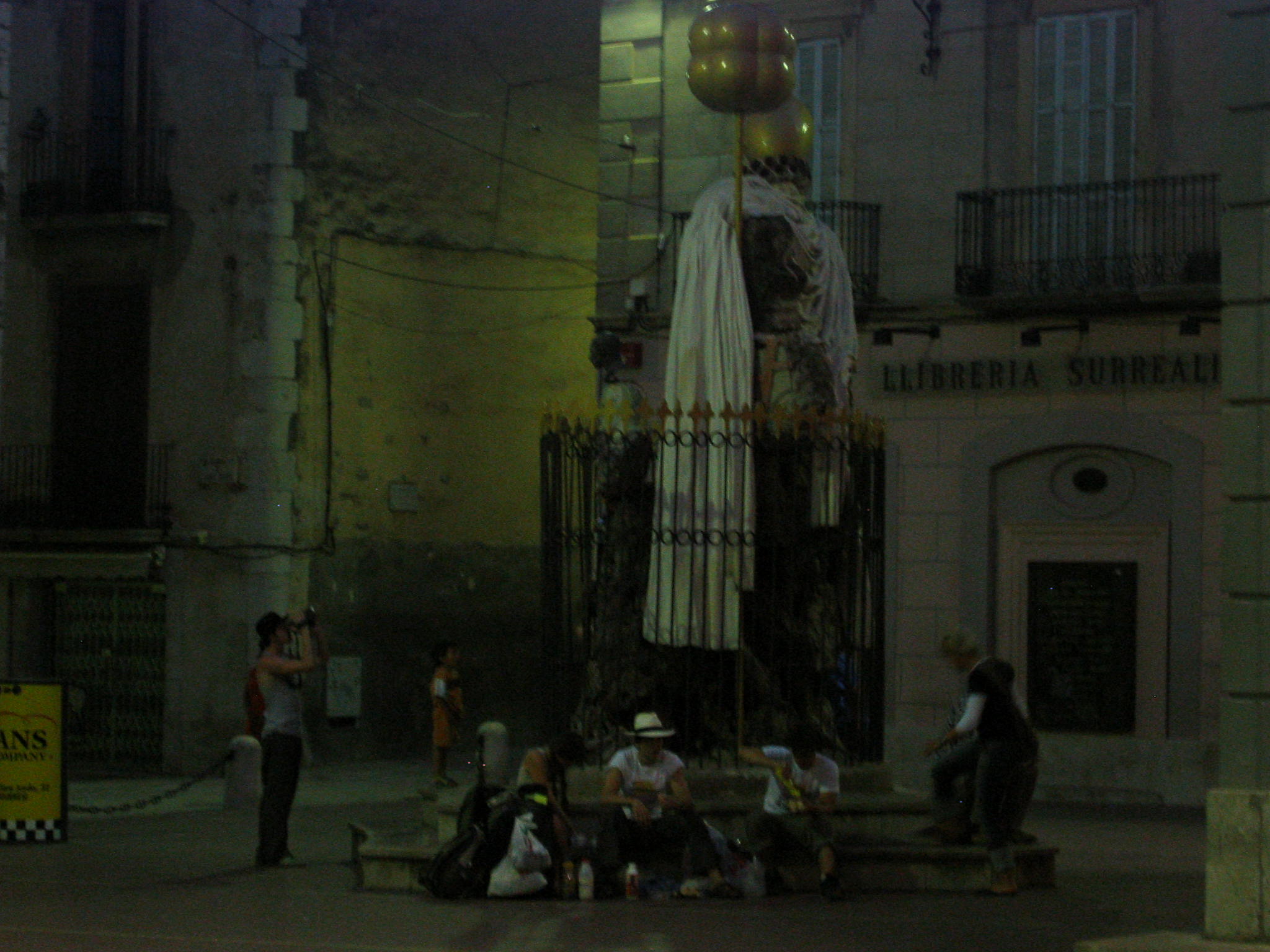
Surrealism is definitely an interesting artistic movement, and one certainly best appreciated through direct first hand experience. There is no where on earth better to have that experience then in the museum designed by Salvidore Dali, the museum that is the tomb of Salvidore Dali, the museum in which every line, every angle and every brick is set to enhance less the particular beauty of the individual pieces of art, but rather to engender and empower the complete sensation of surrealism. To be in that place seemed like it was to walk through a human mind and watch in glimpses the various forms and shadows of its subconscious, its morality, its memories, and its dreams. You arrived for the evening opening at nine, and left at midnight with a headache, and having fallen for a cunning trap.

It was not until you arrived at the train station in the tiny town that you realized that a museum that opens at nine and closes at midnight closes at the same exact moment as the train station, thereby forcing all foolish tourists to spend their money on a hotel. You were wily and unwincing in your approach to defeating this trap. You were also broke, so you and your troupe slept on the ground outside the train station.
The events of that night were many and varied. There were British backpackers camping there also, and they became your allies in the face of police inspections, drunken gangs, the middle aged gay stalker man, and the hours and hours and hours of muffler-less moped driving teenagers doing circles.
Then, after a night that was restless in its truest meaning, you caught the nine a’clock train here. Here is desolation, dubbed “desperado ville” by Gaelyn, a concrete platform in the middle of dry desert that bears more akin to an old western film then to real life. There are no tumbleweed.

The problem is that the chests do not fit on trains. It is a real problem.
The other problems are hunger and thirst and heat, which make thinking hard, and movement unpleasant. In the end, you grin, bear it, and hammer you unwilling chests in through the upper half of a not quite large enough doorway while making sure the train attendants aren’t looking.
An hour or so later they find the chests and kick you off, but by then you’re at a train-station that has more then one train and you manage to find your way north and east, heading for Nice. You have to change trains twice more, and once requires a change of station too. Here the chests are too big for the commuter buss between stations, which is no surprise, so you set out to walk the five kilometers on foot, and it is then that you receive some aid.
Half a mile down the dark and winding metropolis roads you suddenly come upon a group of colored men, laughing and talking and walking together, by all appearances just out for a friendly walk in the evening. You pass them in the street and only a few hundred feet later take the care to glance back. One of them has broken with the others and is approaching Darla. He exchanges a few words with her, and then suddenly begins speaking loudly in french. His words are foreign, however his meaning is clear. He says he will escort you to the train station, because the way you are going is very dangerous. He says not to follow the signs – they lead through a section of town where gangs operate, a place that is not safe for five tourists pushing three hundred pounds of wooden chests at night. You share suspicious glances with your friends, but there is something about this man that you, not trust precisely, but you are willing to give him a chance. He takes the lead, smiling and chatting in french. At one point he tells Darla to stay close, to stay in the middle of the group and hold hands with someone. He smiles when he talks, and there is nothing about his smile that is unwholesome. His eyes are bright, open and kind. He seems genuinely concerned for you. If he is acting, then he is very good at it.
The winding streets unfurl before you. The stranger leads you through quiet, middle class neighborhoods where parents are walking their children by the side of the road. Your chests are the largest moving objects you see. You keep the pace up, knowing that you have only about an hour to make it to the station before your train is gone.
After leading you in a large arch, presumably around the danger, the stranger stops under a bridge and with another open smile points to the highway above you and gives a few final directions. You are almost there, just a little further. Then he gives a final handshake and wave and walks away into the night. It turns out his directions were accurate. You arrive at the train station just a few minutes later and catch your train. There will be one more stop before Nice, but you’re almost there.
Was it really so unsafe? Were the gangs so bad as to warrant such extreme caution? Who was that gentle stranger, and why did he go so far out of his way to help us? Questions to which the answers will probably never be known.
The train deposits you in a train station in yet another city whose name you cannot remember. Immediately as you disembark a security guard tells you in unequivocal terms to leave the station. Now. You try to ask him when the train will come in the morning and he merely crosses his arms in front of him in the universal symbol for negation and says firmly and angrily “out!” You try to ask another guard as you step out the front door if he knows of a cheep hotel and the first nearly shouts at you “this is a train station not a hotel! Get out!” You are already outside, you cannot believe his attitude.
For the second night in a row you are obliged to sleep on the concrete outside a train station. This night is better then the first, perhaps you are getting used to it. At five in the morning you wake up and catch the train that actually goes to Nice. Arriving there in a dull stupor, you find your way to a hostel 16 euro a night, and crash. The next day you wander the city and spot a few pitches. You are still broke but the apartment the hostel gave you has a kitchen and you discover that you can spend the 16 american dollars still in your bank account to buy food at the monoprix, so you have something to eat.
The next day you do two performances and earn a total of two euro and fifty cents.


Feeling awful, you try to find a new pitch, and then, walking through the crowded city center, you come face to face with Mariam. You knew she was here, but you’d been unable to contact her. Her face lights up, and laughter fills the group. It’s her birthday, and she had planned to spend it just rollerblading around the city. The rest of the evening is surreal. Gelatto occurs. The best you’ve ever had. Rose and ginger and passion-fruit and Irish-cream and many others. At last you make it back to bed, and sleep.
The next day you do six shows and feel great about them, tying your record for the most shows you’ve done consecutively, and earning a record of a one hundred and thirty five euro, which is almost thirty each. It looks like you’ll stay in Nice for a little while longer.
It is the following morning that you update your e-journal. Life is good.